India vs Namibia is an intriguing cricket matchup that brings together one of the world’s strongest international cricket teams and an ambitious Namibian side eager to make its mark on the global stage. India has a rich cricketing history, a large pool of experienced international players, and a reputation for performing under pressure. Namibia, meanwhile, has steadily developed its cricketing structure and gained valuable experience through international tournaments and competitions against established teams.
Matches between these sides offer an opportunity to examine the difference in experience, playing resources, tactical approaches, and competitive preparation. India generally enters such contests with expectations of controlling the game through its batting depth, bowling variety, and fielding standards. Namibia can respond with disciplined bowling, aggressive batting, and determined teamwork.
For fans, India vs Namibia is more than a contest between two teams. It is also an opportunity to discover emerging players, evaluate team combinations, and appreciate the growth of international cricket beyond its traditional powerhouses. The format, venue, pitch conditions, and confirmed playing XIs all influence the final outcome, making a careful match preview useful for anyone following the game.
India vs Namibia: Team Overview
India is one of cricket’s most successful international teams, with a strong record across Test cricket, One Day Internationals, and Twenty20 Internationals. Its cricketing system regularly produces technically skilled batters, fast bowlers, quality spinners, and versatile all-rounders. This depth allows the team to adapt to different conditions and select combinations suited to a particular opponent.
Namibia has built a competitive reputation in associate and international cricket, particularly through its performances in limited-overs competitions. The team has benefited from regular exposure to international tournaments and the development of players who can contribute in multiple roles. Namibia’s ability to compete effectively depends on consistency, smart decision-making, and taking advantage of key moments.
When evaluating India vs Namibia, it is important to consider the teams’ different competitive backgrounds without underestimating either side. India’s greater depth can provide an advantage, but cricket remains a game in which partnerships, bowling spells, dropped catches, and pressure situations can change the direction of a match.
Head-to-Head Record and Previous Meetings
Head-to-head statistics provide useful context when comparing two international cricket teams. However, the number of previous meetings between India and Namibia is limited compared with India’s contests against other major cricketing nations. The format of each match also matters because performances in T20 cricket cannot automatically predict the outcome of an ODI or Test match.
A reliable head-to-head assessment should include the total number of meetings, wins for each team, the competition in which the matches took place, and individual performances. Recent form should be considered separately because players, coaching strategies, and team combinations change over time.
| Comparison factor | India | Namibia |
|---|---|---|
| International experience | Extensive across formats | Growing international experience |
| Batting resources | Strong depth and varied styles | Dependent on partnerships and role clarity |
| Bowling options | Pace, spin, and all-round options | Pace and spin options suited to conditions |
| Fielding priorities | Consistency and athleticism | Discipline and pressure management |
| Main objective | Control the game and meet expectations | Challenge the opposition and create opportunities |
For accurate historical analysis, readers should check the scorecards for the specific tournament or fixture being discussed. This avoids confusing past meetings with upcoming matches or mixing statistics from different formats.
India’s Batting Strength and Key Players
India’s batting is often built around a combination of technically sound top-order players, attacking middle-order batters, and finishers who can accelerate late in an innings. This balance is especially valuable in T20 cricket, where teams must manage wickets while maintaining a high scoring rate.
The opening batters play an important role in establishing momentum. They need to judge the new ball, identify scoring opportunities, and avoid unnecessary risks during the early overs. The middle order must then respond to the match situation, whether that means rebuilding after early wickets or increasing the scoring rate against a tiring bowling attack.
All-rounders can provide additional flexibility by strengthening the batting lineup while contributing overs with the ball. India’s selection strategy may change depending on the format, the venue, player availability, and the opposition’s strengths.
In an India vs Namibia fixture, India’s batting advantage is most likely to be effective when the team builds partnerships instead of relying entirely on individual brilliance. Maintaining a steady scoring rate, rotating the strike, and targeting suitable bowling matchups can help India establish control.
Namibia’s Batting Approach
Namibia’s batting strategy generally needs to balance aggression with careful shot selection when facing a team with India’s bowling resources. A strong start can help Namibia compete, but the team must also preserve enough wickets and capable batters for the later stages of the innings.
The top order should focus on reading the conditions and responding to the bowling attack. If the pitch offers movement or extra bounce, patience may be necessary. On a good batting surface, Namibia could look to exploit scoring opportunities through well-timed boundaries and efficient running between the wickets.
Middle-order stability is equally important. A team that loses wickets in clusters can struggle to build a competitive total, even when the opening overs are promising. Namibia therefore benefits from partnerships that allow batters to settle before accelerating.
Against India, Namibia can create pressure by targeting loose deliveries, converting singles into twos, and selecting specific bowlers to attack. A disciplined batting performance would improve the team’s chances of remaining competitive throughout the match.
Bowling Comparison: Pace, Spin and Control
Bowling can determine how quickly a contest develops. India usually has access to a broad range of bowling styles, including fast bowling, swing options, wrist spin, finger spin, and all-rounders who provide additional overs. This variety can help the captain respond to different phases of a limited-overs innings.
Namibia’s bowlers need to focus on accuracy, effective changes of pace, and well-planned field placements. Against aggressive batters, repeatedly bowling predictable deliveries can allow the opposition to dominate. Mixing lengths and speeds, attacking the stumps, and using variations at appropriate moments can make scoring more difficult.
In T20 cricket, the powerplay, middle overs, and death overs require different approaches. Early wickets can restrict the batting side, while disciplined middle-over bowling can slow scoring. At the end of the innings, yorkers and carefully executed slower balls may reduce boundary opportunities.
The bowling contest in India vs Namibia will depend on the pitch, weather, team selection, and the ability of each side to execute its plans. A team that limits extras and creates regular wicket-taking opportunities can gain a significant advantage.
Key Players and Match-Winning Contributions
Individual performances can shape a match, but identifying the most important players requires the confirmed squad and playing XI. India’s influential players may include top-order batters, specialist bowlers, and all-rounders capable of changing the game in several disciplines. Namibia’s key contributors may be experienced international campaigners, dependable batters, or bowlers who perform particularly well in limited-overs cricket.
Rather than relying only on reputation, fans should consider recent performances, fitness, role in the team, and suitability for the conditions. A batter in good form may be particularly valuable on a flat pitch, while a spinner could become more influential on a dry surface that offers turn.
Important contributions to watch include:
- A strong opening partnership that gives the batting team a confident start.
- A middle-order batter who stabilizes the innings after early wickets.
- A bowler who takes wickets during the powerplay.
- An all-rounder who contributes with both bat and ball.
- A sharp fielding performance that prevents boundaries and creates run-out opportunities.
These contributions are relevant regardless of the final result and help explain why some teams perform better than expected.
Pitch Conditions and Weather Impact
Pitch conditions can influence the balance between bat and ball. A hard, even surface may help batters play their shots, while a slower pitch can reward bowlers who vary their pace. Grass cover and moisture may assist seam movement, whereas a dry surface could provide opportunities for spin.
Weather is another important factor. In outdoor matches, humidity, cloud cover, temperature, and rain interruptions can influence tactics. In limited-overs cricket, a shortened match may require a more aggressive batting approach and different bowling plans.
The toss can also affect team decisions. Depending on the venue and format, captains may prefer to bat first and set a target or bowl first to assess the conditions. There is no universally correct decision because pitch behavior and weather can change during a match.
Before making a prediction about India vs Namibia, fans should assess the official venue report, expected weather, and confirmed team selections rather than assuming that historical trends will determine the result.
India vs Namibia: Latest Match Result and Scorecard
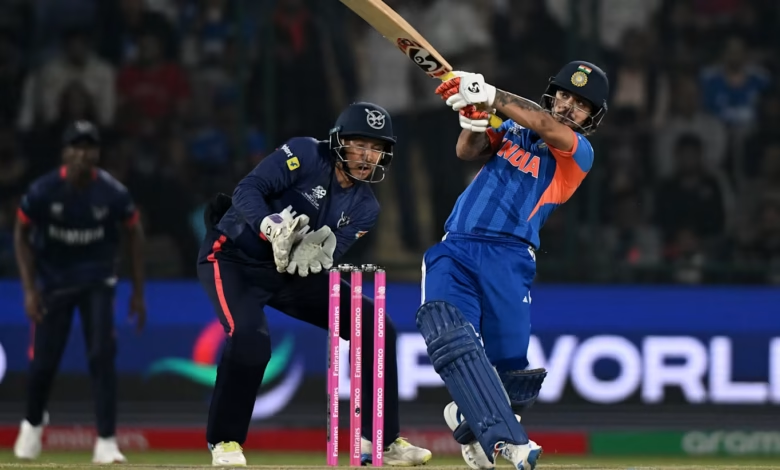
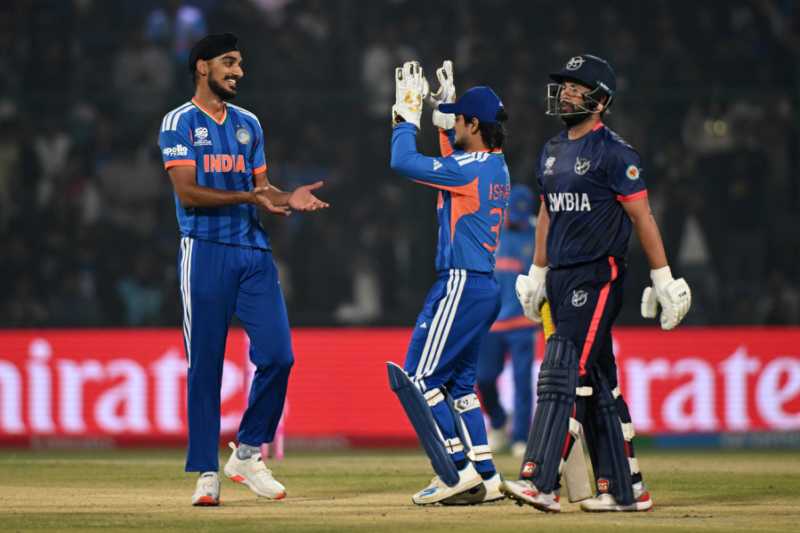
The India vs Namibia match in the ICC Men’s T20 World Cup 2026 took place on 12 February 2026 at the Arun Jaitley Stadium in Delhi. India delivered a commanding performance, scoring 209/9 in 20 overs before bowling Namibia out for 116 in 18.2 overs to secure a 93-run victory. The result highlighted India’s batting firepower and its ability to put pressure on the opposition with the ball.
Ishan Kishan played an explosive innings of 61 runs from 24 balls, providing India with rapid scoring at the top of the order. Hardik Pandya also made a major contribution, scoring 52 from 28 deliveries. Their performances helped India establish a challenging total despite losing wickets during the innings.
Namibia found the chase difficult against India’s bowling attack and could not sustain the partnerships required to threaten the target. The final margin demonstrated the impact of India’s strong batting start and effective bowling execution.
| Match detail | Result |
|---|---|
| Tournament | ICC Men’s T20 World Cup 2026 |
| Date | 12 February 2026 |
| Venue | Arun Jaitley Stadium, Delhi |
| India innings | 209/9 in 20 overs |
| Namibia innings | 116 all out in 18.2 overs |
| Result | India won by 93 runs |
| India’s leading batter | Ishan Kishan, 61 off 24 balls |
| Another key performance | Hardik Pandya, 52 off 28 balls |
Memorable Previous Encounters
India and Namibia have met in international cricket on a limited number of occasions. Their 2003 ODI encounter took place during the Cricket World Cup, when India recorded a substantial victory. The teams subsequently met in the 2021 Men’s T20 World Cup, where India won by nine wickets after restricting Namibia to 132/8.
In the 2021 match, Ravindra Jadeja took three wickets for 16 runs, helping India control Namibia’s innings. India then completed the chase comfortably, with Rohit Sharma and KL Rahul scoring half-centuries. The match illustrated how early wickets and disciplined bowling can create a straightforward chase for a strong batting lineup.
The 2026 encounter added another significant result to the history between the sides. India again won convincingly, but the match also offered Namibia valuable experience against high-quality international opposition. Such fixtures can help developing teams identify areas for improvement and prepare for future tournaments.
Match Prediction and Tactical Outlook
A match prediction should account for the format, current team form, confirmed lineups, venue, and player availability. India often has an advantage because of its depth in batting and bowling, but that advantage must still be converted into consistent performances on the field.
Namibia’s best opportunity is to compete through disciplined bowling, strong fielding, and partnerships that reduce pressure on individual batters. Taking early wickets against India could disrupt its preferred batting strategy, while a competitive total would give Namibia’s bowlers something meaningful to defend.
For India, a solid start, flexible middle-order batting, and wickets during the opposition’s powerplay are important factors. Avoiding unnecessary extras and maintaining pressure during the middle overs can also limit Namibia’s scoring opportunities.
Fans should distinguish between a prediction made before a fixture and an analysis of a completed match. For the February 2026 meeting, the result is already established: India won by 93 runs. Any discussion of a future India vs Namibia fixture should be based on that fixture’s own conditions and team selections rather than assuming the same outcome.
What Makes This Match Interesting for Cricket Fans?
Matches between established teams and developing international sides provide a broader view of cricket’s global growth. India brings a long history of high-level competition, while Namibia represents the progress of a team working to strengthen its position in international cricket.
These games also offer several talking points for supporters:
- Batting quality: Fans can evaluate how top-order batters manage pace, spin, and pressure.
- Bowling tactics: Different bowling combinations show how captains adapt to match situations.
- Emerging talent: International fixtures provide opportunities for less-established players to gain experience.
- Team strategy: Field placements, batting order decisions, and bowling changes can influence the result.
- Tournament impact: Every group-stage match can affect team momentum and qualification prospects, depending on the competition format.
Following these factors makes a cricket match more engaging than simply checking the final score. It also helps readers understand how individual contributions combine to shape a team’s performance.
Conclusion
India vs Namibia is a compelling international cricket matchup that highlights the contrast between India’s extensive cricketing resources and Namibia’s determination to compete at the highest level. Their previous meetings have generally favored India, including the 2021 T20 World Cup encounter and the 2026 T20 World Cup match in Delhi.
The latest meeting ended with India scoring 209/9 and restricting Namibia to 116 all out, producing a 93-run victory. Ishan Kishan and Hardik Pandya were important contributors with the bat, while India’s overall bowling effort helped secure the result.
For readers following future fixtures, the most useful factors to monitor are recent form, player availability, pitch conditions, batting partnerships, and bowling execution. Understanding these details provides a clearer picture of the contest and helps fans appreciate the tactical decisions behind every innings. As Namibia continues to gain international experience, future encounters will offer further opportunities to assess its progress against one of cricket’s leading teams.