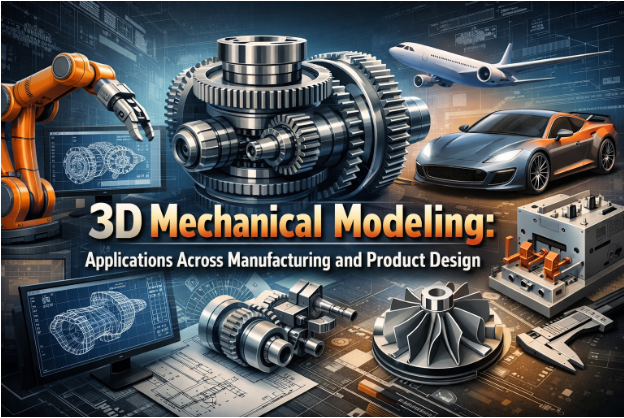
With increasing product complexity and shrinking product development time, tools must provide greater accuracy, collaboration, and velocity. 3D Mechanical Modeling is one of the most critical enablers of this change.
With 3D mechanical modeling, digital models of mechanical parts and assemblies can be created accurately, and products can be tested and developed even before they are manufactured.
Starting from industrial equipment and consumer goods, today, mechanical modeling is right at the heart of every manufacturing and product design process.
What Is 3D Mechanical Modeling?
3D mechanical modeling is a method of building accurate models of mechanical parts using computers.
As compared to conceptual or picture models, mechanical models emphasize the following:
- Dimensions and tolerances
- Functional relations between parts
- Material properties and structural logic
- Assembly and disassembly behavior
This accuracy renders mechanical modeling highly usable in engineering, simulation, and production planning.
Role in Contemporary Manufacturing Processes
The manufacturing industry today relies to a great extent on digital validation. Prototyping a product physically is quite pricey and takes a long time; hence, the rise in the use of virtual validation by manufacturers.
3D Mechanical Modeling assists manufacturing in the following ways:
- Facilitating the digital test of fit and functionality for engineers
- Identifying design flaws before production tooling
- Minimizing Material Waste and Rework
- Promoting CNC machining and Additive manufacturing
What it means is that a precise model facilitates a smoother transition between design and production.
Product Design and Engineering Applications
Mechanical modeling helps engineers to design individual elements as well as assembly modules. They are also capable of analyzing interaction effects of components to avoid interferences and alignment problems.
Assemblies can be analyzed for:
- Macro-motion and articulation
- Clearance and collision
- Ease of assembly and maintenance
Such products have better designs with fewer surprises during their production processes.
Design Iteration & Optimization
Another large benefit of 3D modeling is rapid iteration. It is easy to make changes to a design and see the effects right away.
Such flexibility enables teams to:
- Optimize Weight and Strength
- Boost performance and longevity
- Cut material costs
Virtual iteration speeds up innovation with development expenses remaining under control.
Simulation & Performance Testing
Mechanical models may serve as an input into simulations such as:
- Thermal performance testing
- Vibration and motion studies
Through simulating conditions like those found in the real world, it is possible to forecast where failures will occur, thus allowing for optimization of designs at an early stage.
Applications in Key Sectors
Industrial Machinery
Heavy machinery and equipment require proper mechanical modeling for safety and maintainability. Modeling enables validation of complex assemblies with hundreds or thousands of components.
Automotive & Transportation
Starting with engine parts right up to chassis components, mechanical modeling aids in the optimization of performance as well as weight reduction and the achievement of safety requirements.
Consumer Products
Even mundane articles like household appliances and electronics can make use of mechanical modeling. Products can not only be pleasing to the eye but also function well.
Robotics and Automation
Robotics systems need accurate motion planning and component interaction. Mechanical modeling enables engineers to simulate motion, load distribution, and wear before implementation.
Collaboration Between Design, Engineering, and Production
One of the greatest aspects of 3D mechanical modeling is the integration it provides. One model can be accessible across various departments, so a team of people can rely on the same source.
This enhances:
- Communication between designers and engineers
- Designers’ communication
Alignment between design intent and manufacturing:
- Documentation for suppliers and manufacturing teams
- Better models mean fewer misunderstandings and a more rapid decision-making process
From Engineering to Visualization and Training
In addition to the field of engineering, mechanical models are being applied at a rising rate for:
- Technical documents and manuals
- Assembly and maintenance instruction
- Marketing and product visualization
Thus, the versatile usage enables the maximum utilization of each model developed.
Why Internet Outsourcing Is Becoming More Prevalent
As products become more complex, several organizations find themselves resorting to 3D game art outsourcing in a bid to have some tasks related to modeling done externally. Organizations with 3D game art outsourcing services and good modeling knowledge can be approached for help in various sectors apart from making games.
Outsourcing assists with:
- Scaling modeling capacity quickly
- Obtaining access to expertise in CAD modeling
- Reduction of workload during intensive development phases
- Offering high-quality, ready-to-publish assets
RWA enables in-house groups to concentrate on engineering while external specialists perform modeling with greater detail.
Accuracy Rather than Appearance
While a 3D asset is only visual, mechanical models require accuracy right down to the smallest detail. Tolerances, orientation, and properties of different materials are important.
High-quality three-dimensional mechanical modeling is ensured with:
- Designs are manufacturable
- Assemblies are working as expected
- Downstream processes are also efficient
Accuracy affects an item directly with regard to quality, safety, and expense.
The Long-Term Value of Mechanical Models
After development, mechanical models remain useful during the lifetime of the end product. Mechanical models work in the following ways: The mechanical model is created through:
- Future revisions and upgrades
- Design of a replacement part
- After-sales support and documentation
This means that mechanical modeling is a long-term goal rather than a single design process.
Conclusion
3D Mechanical Modeling has become an essential building block in the world of manufacturing and product development. It has been able to create better products in shorter amounts of time due to the capabilities offered by 3D mechanical modeling.
Ranging from industrial and automotive systems to consumer goods and robotics, mechanical modeling enables innovation at all stages. Together with a strategy of appropriate outsourcing, most likely in collaboration with a 3D game art outsourcing company with relevant modeling knowledge, businesses can scale with a focus on accuracy and quality.
And in the increasingly competitive and complex world of products, mechanical modeling has become more than just a design aid – it has become a powerful competitive advantage.
